Had them out after the back steps started going soft underfoot. He came and looked properly before quoting anything, and told me the structure underneath was still sound — so it ended up a smaller job than I had braced myself for. Turned up when he said he would, cleaned up after himself, and the price at the end was the price we agreed. Not much more you can ask for.
Owner replied
S
Skyler White
9 months ago
Called on a Tuesday and had someone out the same week. What I appreciated most was being told straight what needed doing now and what could safely wait until spring. No pressure and no trying to talk me into the bigger version of the job. It has held up fine through the winter since.
T
Trevor Alford
2 months ago
The quote came through itemised and the final bill matched it, which has honestly not been my experience with everyone around here. They worked around an awkward driveway without once making it my problem, and left the place tidier than they found it. Would have them back.
K
Kaleb Withrow
3 weeks ago
Fair price, showed up on time, tidy work. No complaints.
Sample reviews shown for illustration.
See something like yours?
Send a few photos and we'll tell you what it'll take — free written quote, no pressure.
Floor joist repair is about the structure under your feet: the joists that carry the floor, the beams and girders that carry the joists, the sill plate where the house sits on its foundation, and the subfloor on top. When any of it fails, you feel it as a floor that sags, bounces, or runs downhill toward one wall.
Rotted joists and girders sistered and supported
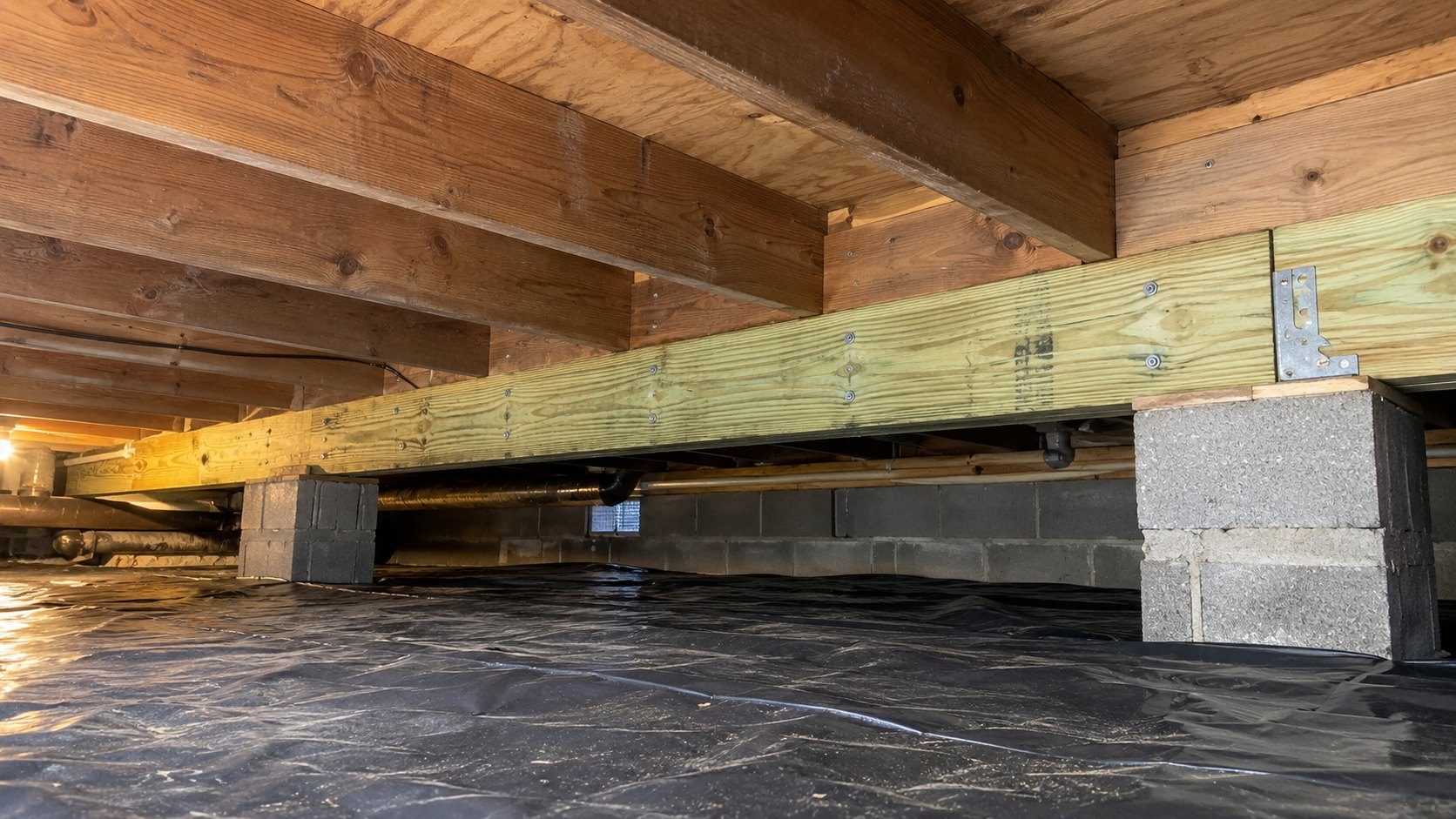
Beam and girder replacement on new posts
Sill plate replacement at the foundation line
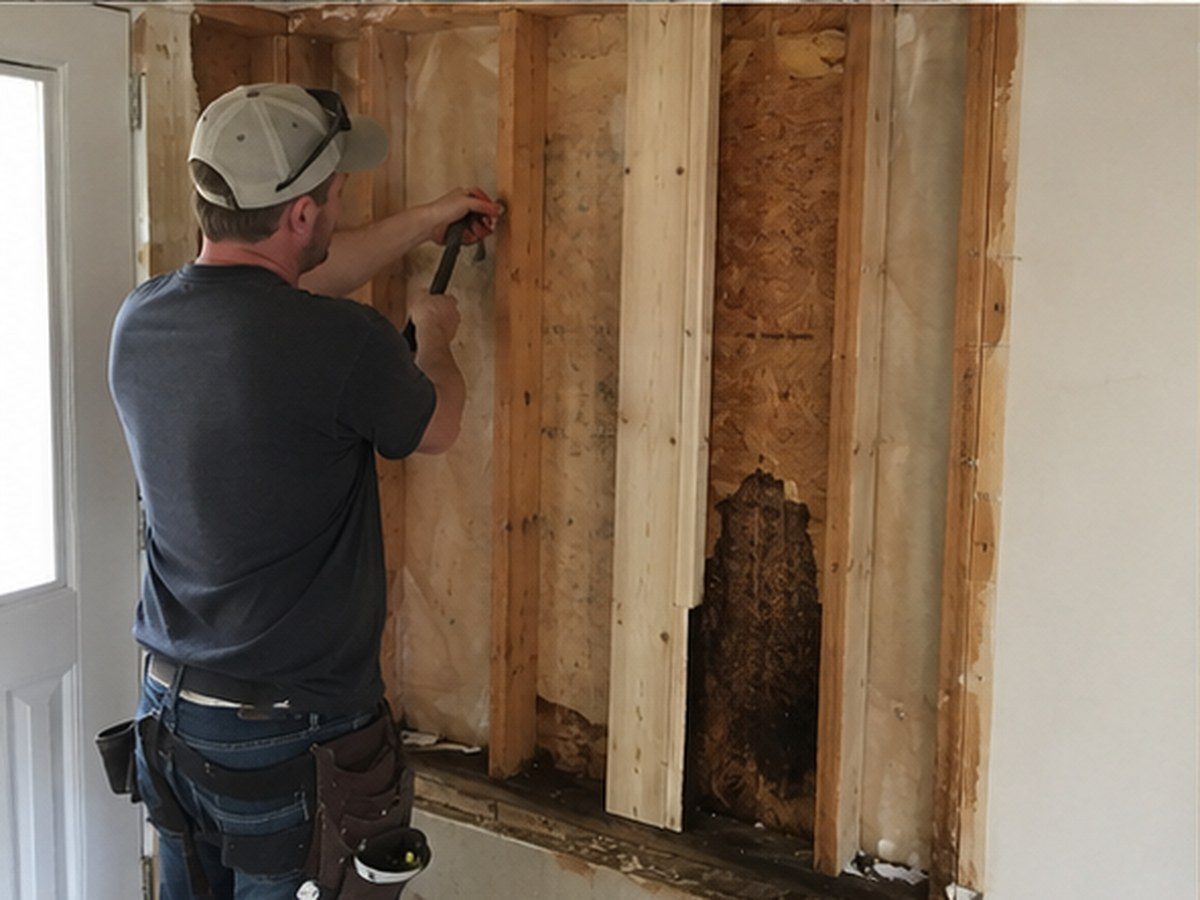
Wall studs replaced where rot has reached them
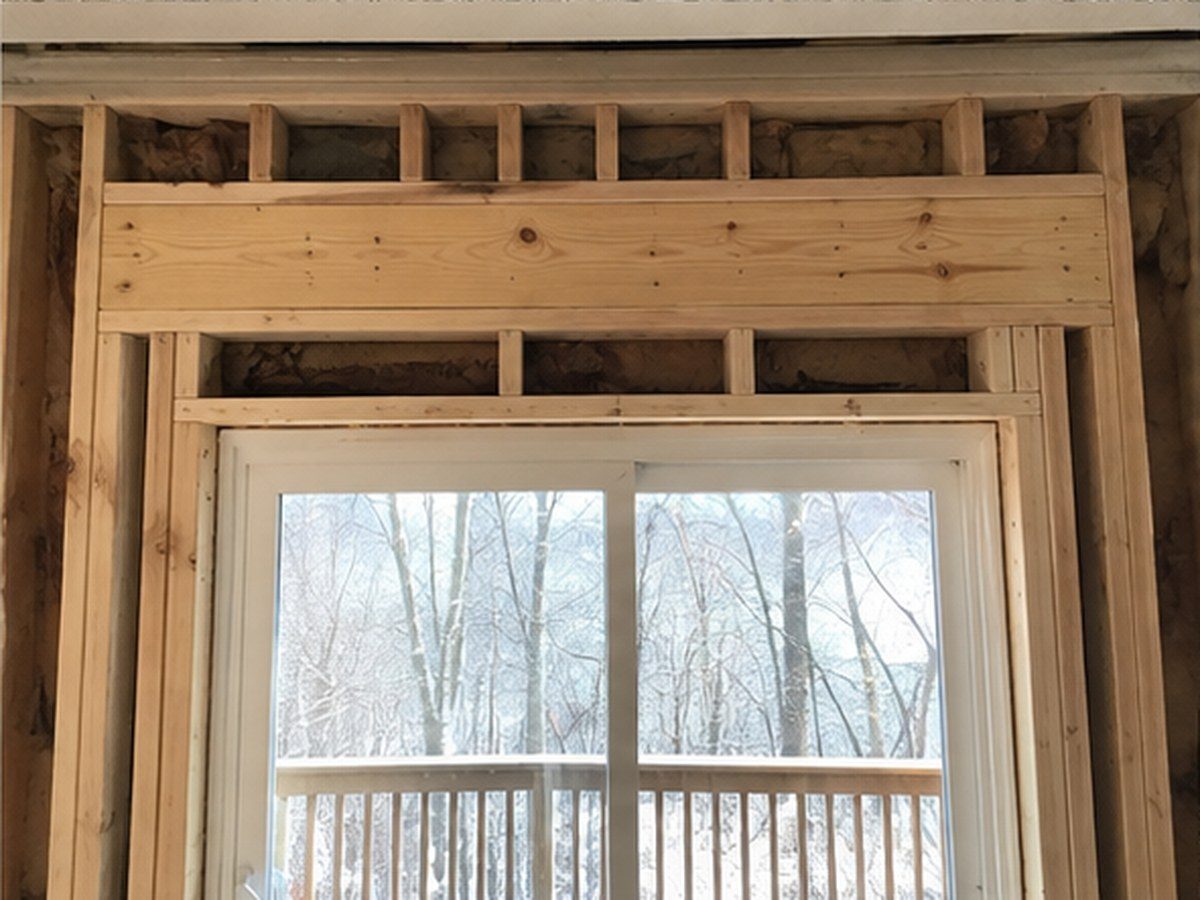
Headers rebuilt over doors and windows
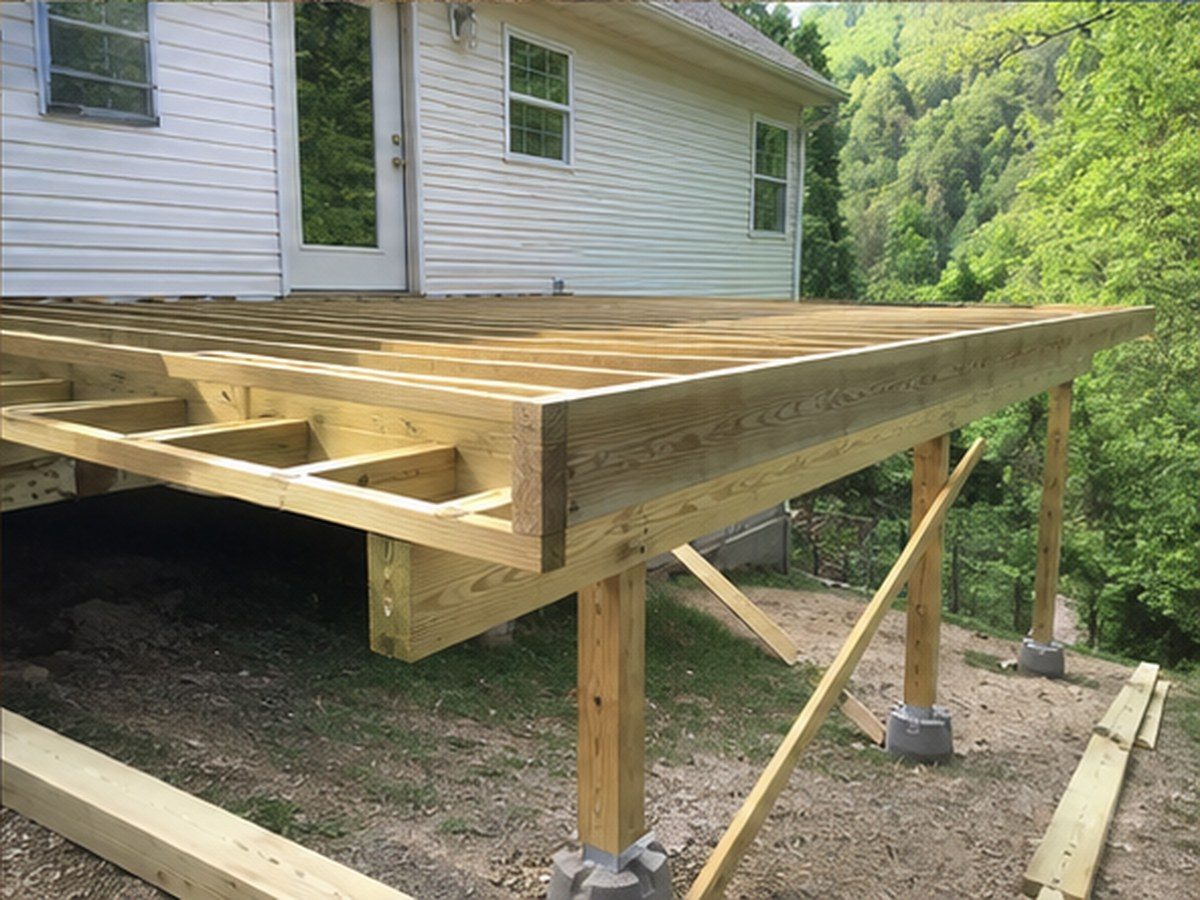
Deck and porch floor framing rebuilt
Why Choose Mackwood Construction?
What you get when Mackwood does your floor joist repair — and what we won't do.
Free written quote, itemised before anything starts
We get underneath and look properly before quoting — not from the kerb
We'll tell you straight if a repair isn't worth doing
Based in Williamson — Mingo and Logan counties, about an hour out
Straight answers on permits, which differ either side of the county line
Built for this climate: drainage, flashing and ground contact done right
From first call to finished work — no surprises in between.
Step 1
Tell us about the project
Call, text, or send a message with what you're looking to build or repair. No form to fill in and no call centre — it comes straight to us, and you'll get a real answer about whether it's something we do.
Step 2
Send photos or schedule a look
A few photos are often enough to tell us what we're dealing with. Where it isn't — anything structural, anything hidden underneath — we'll come out and look properly before quoting rather than guessing from the kerb.
Step 3
Get a clear quote
You get a written quote that itemises the work, so you can see what you're paying for and what you aren't. If we think part of it isn't worth doing, we'll say so. No pressure and no surprises at the end.
Step 4
We build it right
We turn up when we said we would, work clean, and haul the offcuts away with us. The job gets built to last in this climate — and we'll walk it with you before we call it finished.
Not sure what yours needs?
We'll come and look, then tell you straight — including if it isn't worth doing.
Floor Joist Repair in Williamson, WV — common questions
Straight answers to what we get asked most.
How much does floor joist repair cost in West Virginia?
This is the hardest carpentry to price sight-unseen, because the extent only shows once it's open. We give a firm number for what's visible and a clear range for what isn't, and explain what would move it either way before starting.
My floor is springy in one spot. Is that serious?
It usually means a joist has cracked, rotted at the end, or been cut for a pipe or duct. It's rarely an emergency, but it doesn't improve on its own, and sistering one joist costs far less than dealing with a failed floor later.
What is sistering a joist?
Fastening a new joist alongside the damaged one so the new member carries the load. It's cheaper than replacement because the old joist stays put. It only works if the sister runs full length and bears properly at both ends.
Do all old houses have sloping floors?
Most houses this age here have some slope, and not all of it needs fixing. The question is whether it's settled or still moving. Doors that have recently stopped closing and cracks that come back after patching point to movement, and that does need attention.
Can you work in a low crawl space?
Usually, though it affects the price. An 18-inch crawl is slow, awkward work compared to a full-height basement. We look before quoting so the number reflects the actual access.
Is my problem framing or foundation?
They produce similar symptoms and the difference matters, because the fixes are completely different. We look at the crawl space or basement to tell which. If it's foundation, we'll say so. That's not our work, and you'd be wasting money having us frame around it.
How long does floor joist repair take?
Sistering a few joists is often one to two days. Beam replacement or sill plate work runs longer because of the shoring and the care it needs. We give a window with the quote.
Will you need a permit?
Structural work often does, and requirements differ between incorporated towns and county addresses, and between Mingo and Logan counties. We confirm what applies to your address before we start.
Can floor framing be saved after a flood?
Often, but not by drying it out and hoping. Flood water hits sill plates, rim joists, joist ends and the bottom of wall studs, the wood closest to the ground. Those get cut back to sound material and replaced.
Someone cut through a joist for a duct. Does that need fixing?
It depends where the cut is and how deep. A notch in the top or bottom edge near the middle of a span is the worst case, because that's where the joist is working hardest. It's a common find in houses that had heating added later, and it's usually straightforward to correct with a sister or a properly framed opening.
What floor joist repair in Williamson actually involves
Most people are buying a result, not a list of tasks. Pick a topic to see how floor joist repair actually gets done and what moves the number.
More on floor joist repair work
Mackwood Construction handles the floor joist repair WV houses of this age need, which is more of it than most people expect. Floors lead the work. Wider framing like wall studs and headers comes into it when the same water or the same settling has reached them too.
What's involved
Subfloor repair where it has gone soft
Temporary shoring while repairs are made
The sagging floor is the symptom
Almost nobody calls about joists. People call about a sagging floor in the kitchen, a door that won't latch, or a crack that keeps coming back after patching. Those are symptoms. The framing under the floor is usually the cause.
That's the trap. Sagging floor repair that stops at the surface doesn't last. Every symptom has a cosmetic fix that works for a season: plane the door, patch the crack, lay new flooring. The symptom goes away, the cause carries on, and the money is gone.
What's involved
Floors that slope, bounce, or feel soft in a spot
Doors that stop latching or drift open on their own
Cracks in drywall or plaster that reappear after patching
Gaps opening between trim and wall, or at ceiling corners
A dip you can see across a room when the light is low
Nail pops appearing in a line across a ceiling
Windows getting hard to open in one part of the house
Why floors fail in houses here
A lot of the housing in Mingo and Logan counties was built quickly as coal-camp housing between the 1920s and 1940s, on hillside lots, often on block or stone piers, with joists sized by eye rather than by span table.
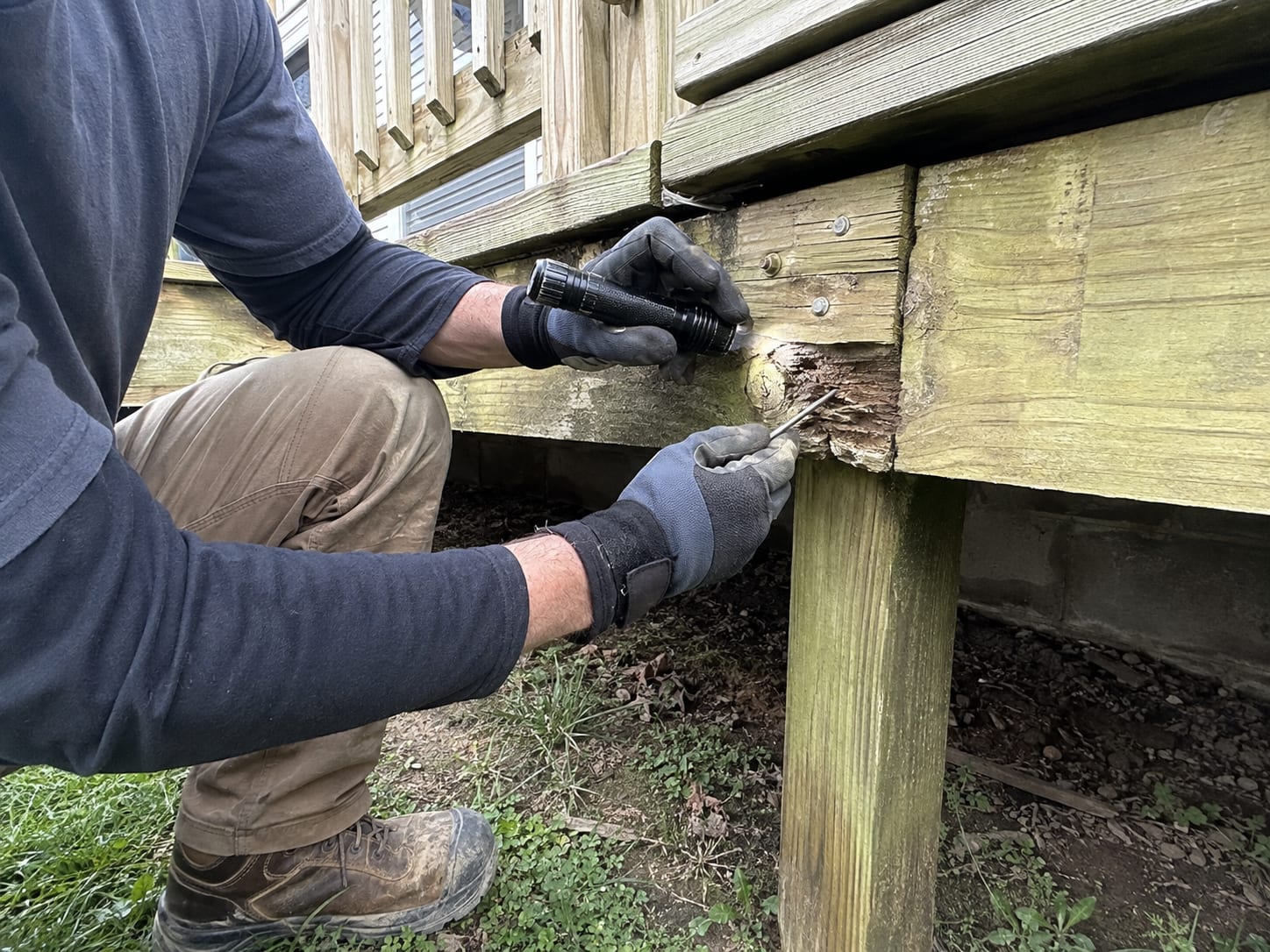
Add a century of moisture. Crawl spaces in this valley stay damp, houses sit in shade, and the rivers have flooded within living memory. The wood closest to the ground takes the worst of it, so a rotted floor joist is usually rotted at the end, where it bears on the sill, rather than in the middle.
Then add changes over the years. Duct runs cut through joists, walls taken out without a header, a bathroom added over framing that was never sized for the load. Each one was fine on its own until it wasn't. That history is why so much of the floor joist repair West Virginia houses need is on older stock like this.
Sistering, and when it's enough
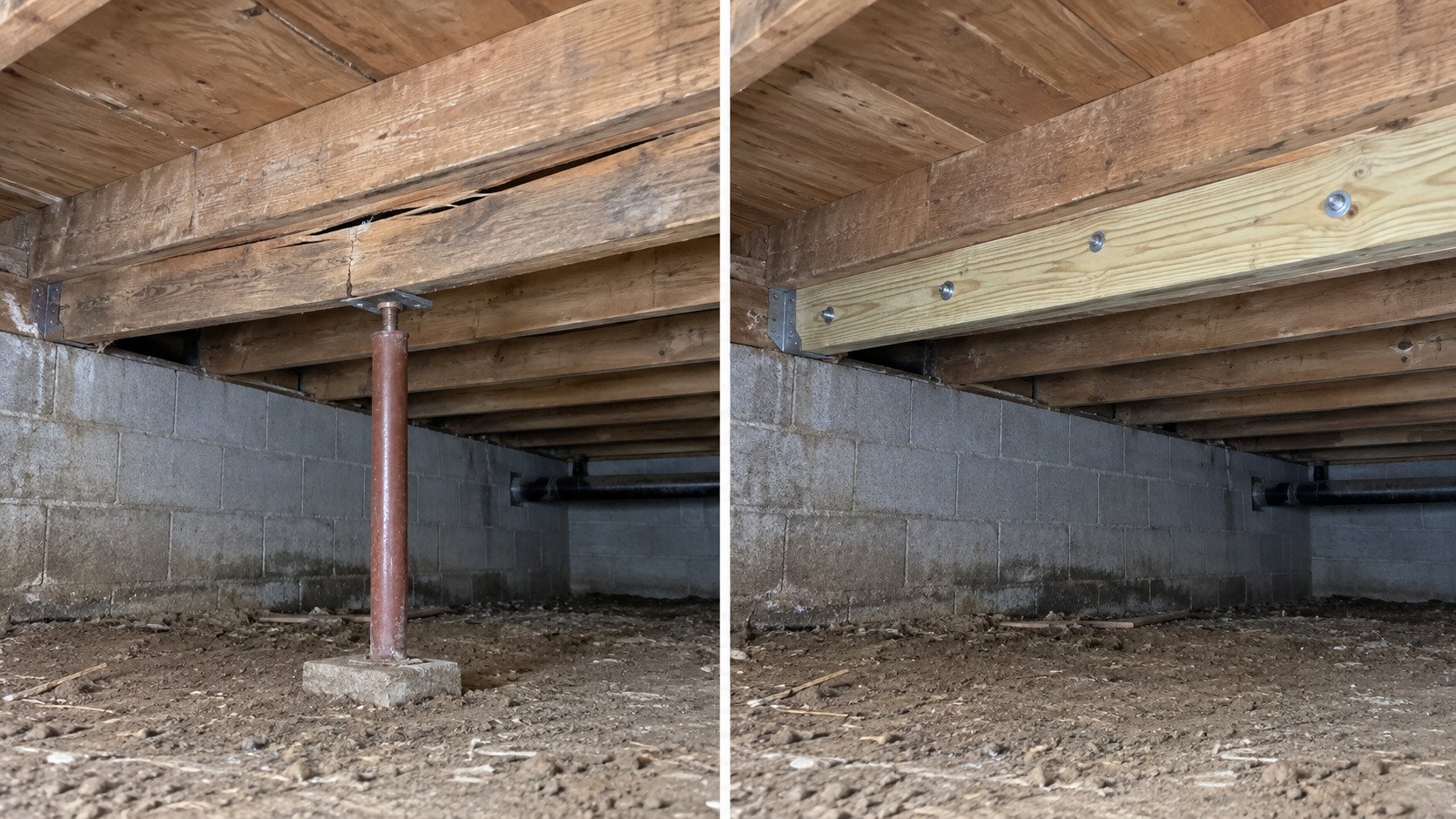
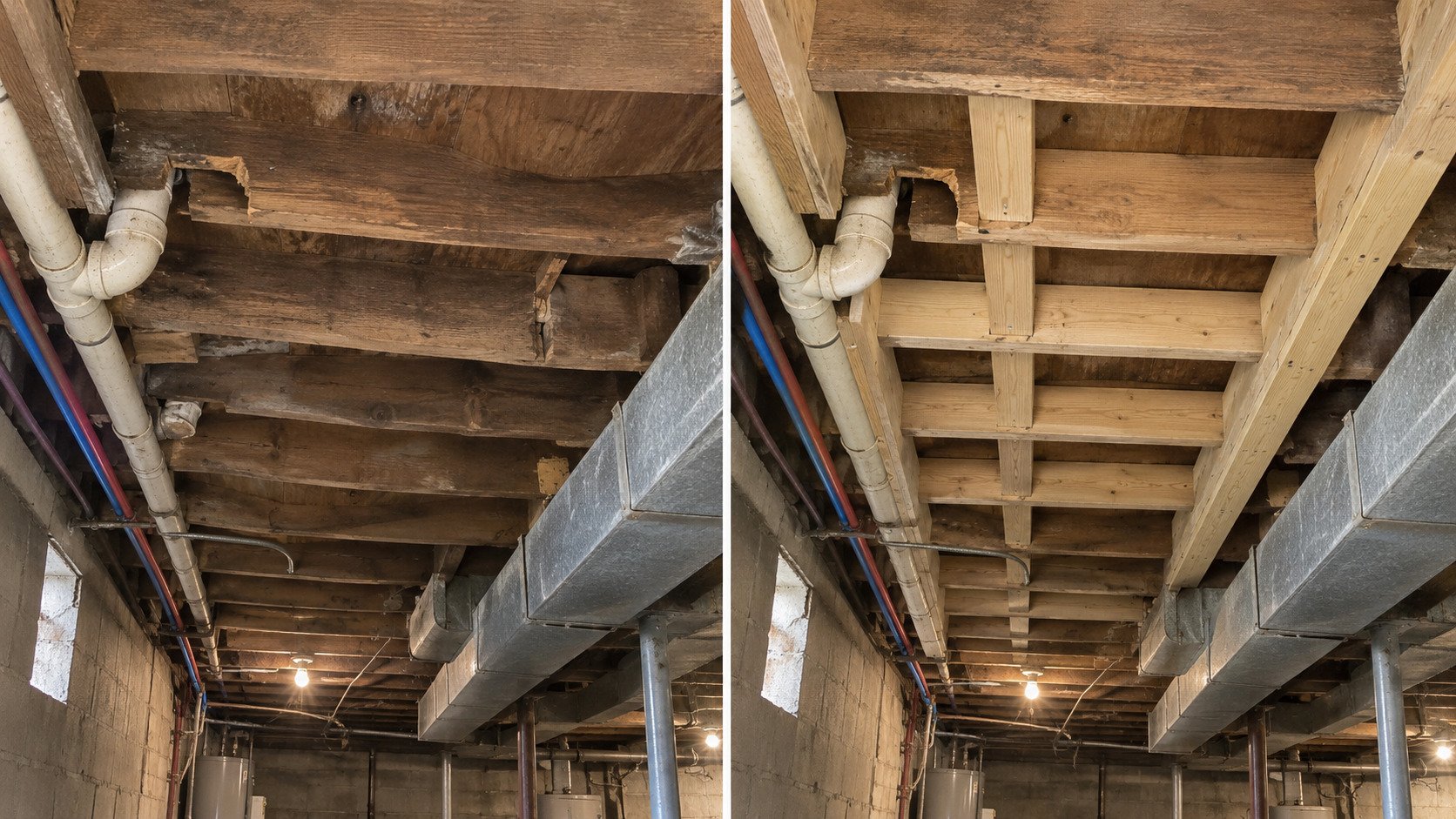
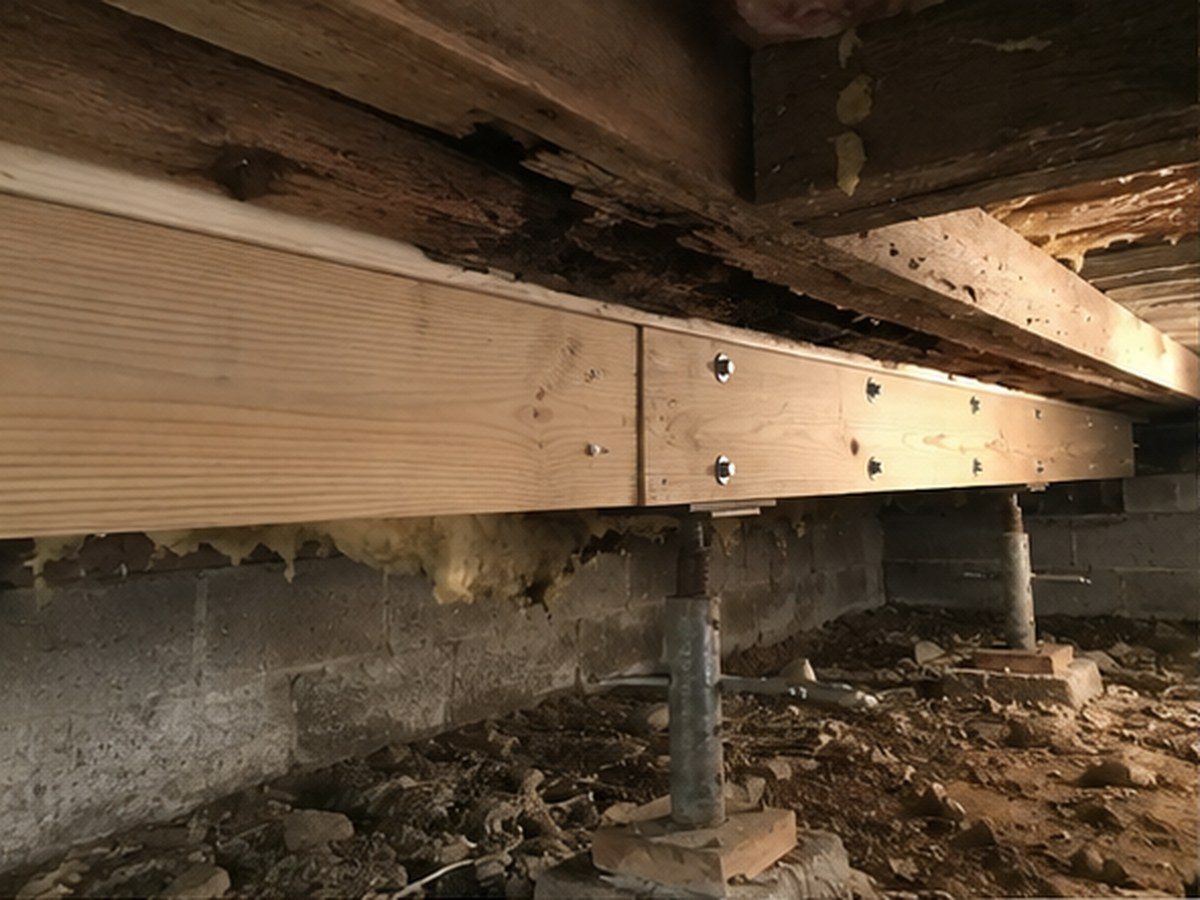
Sistering means fastening a new joist alongside a damaged one so the new member carries the load. It's the standard repair for a cracked or sagging joist, and it costs a good deal less than replacement because the old joist doesn't have to come out.
It only works under conditions. The sister has to run full length and bear on the same supports at both ends. A short scab over the damaged section transfers nothing. And the original has to be sound enough at the bearing points to matter.
Where the damage is at the bearing end, where rot has gone right through, or where the whole floor is undersized rather than one joist being damaged, sistering isn't the answer and we'll say so.
Floor joist replacement
When a joist has rotted through at the bearing, been cut through for a pipe, or cracked along its length, it comes out. Floor joist replacement means supporting the floor above while the old member is out, then fitting a new one at full length so it bears properly at both ends.
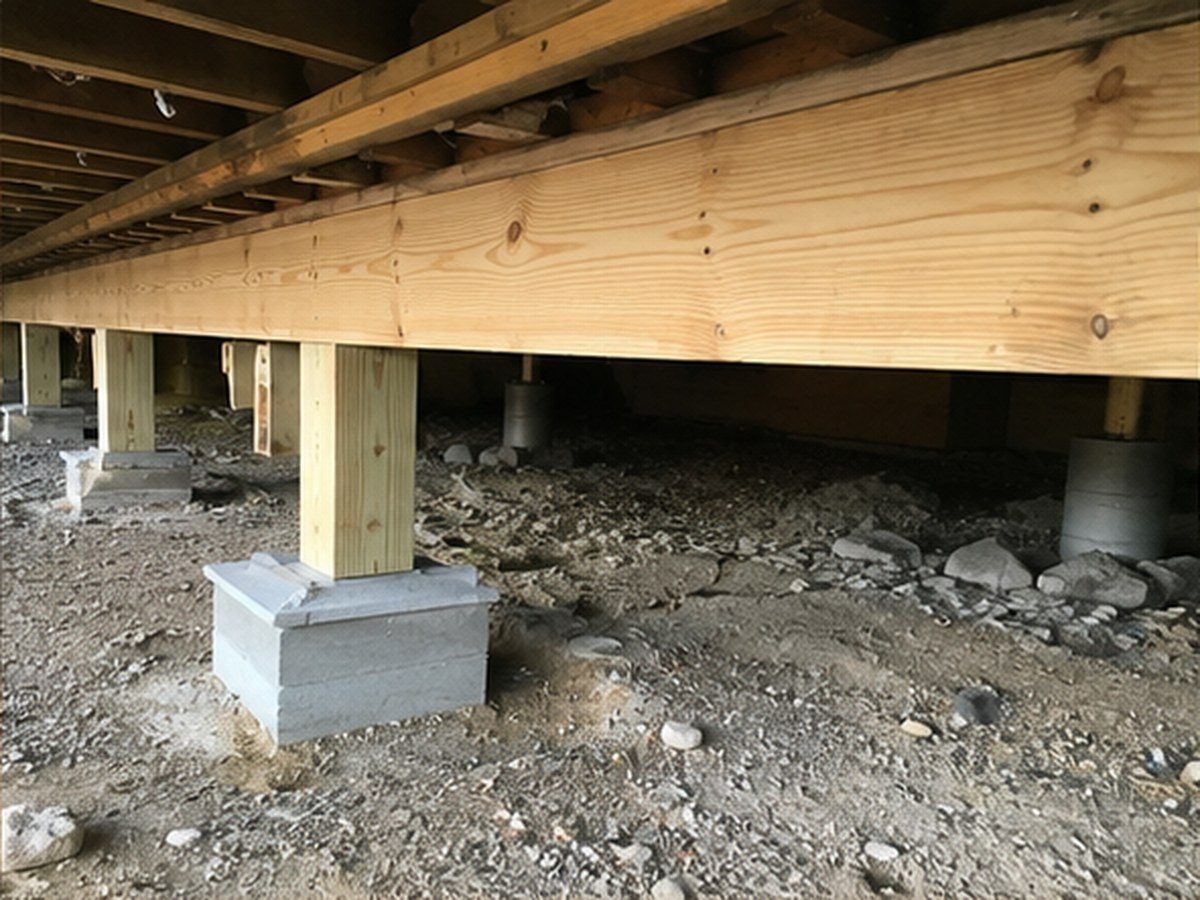
The same goes for a girder, the heavier beam under the middle of many older houses that the joists rest on. When a girder sags between its posts, every joist on it sags too. Supporting it with new posts, or replacing it, brings a whole section of floor back rather than one joist.
Floors that have sat low for decades come back gradually. Jacking a ninety-year-old house up in one go cracks plaster and opens joints that were fine, so it's done in stages.
Sill plates and the ground-level problem
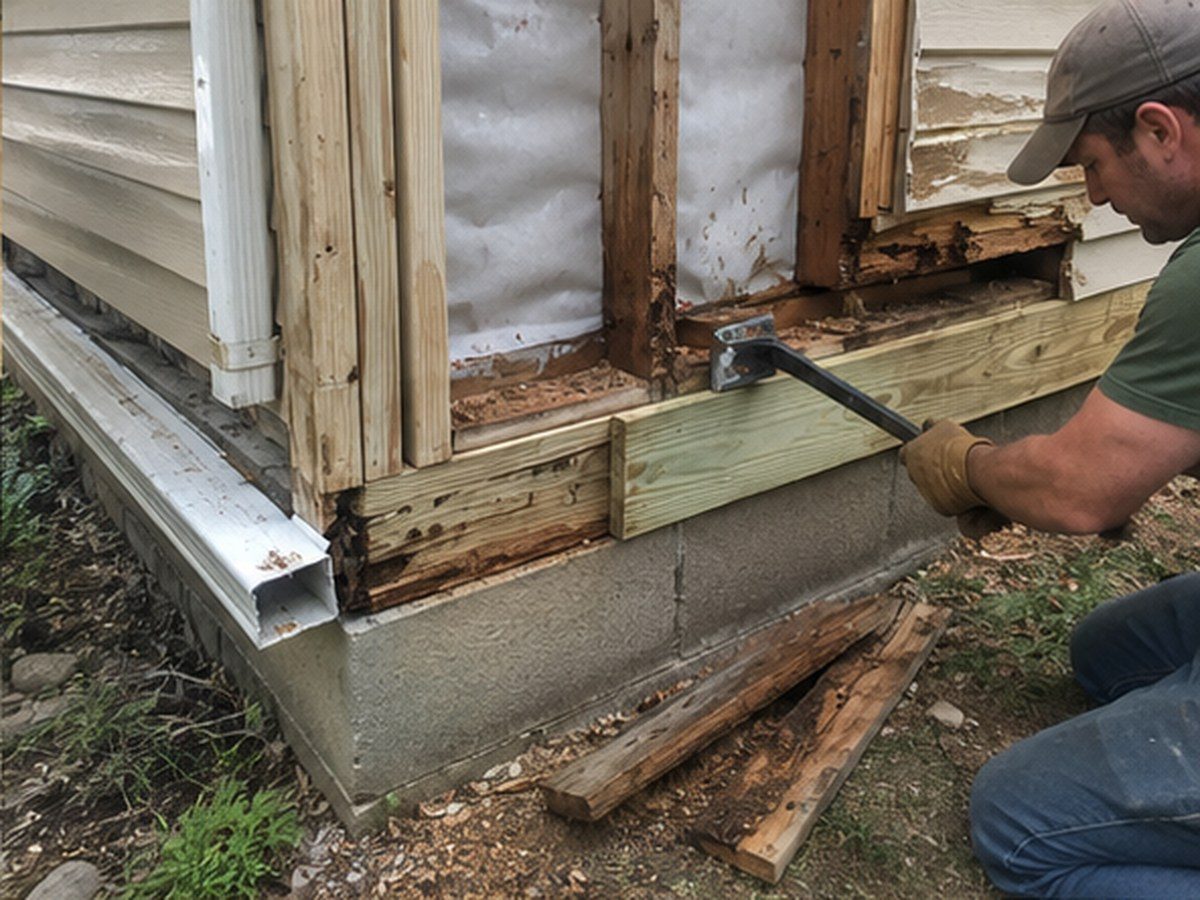
The sill plate is the timber on top of the foundation that everything above it is built on. It's the most common serious framing failure in older houses here, because it's the lowest wood in the structure and it sits on masonry that wicks moisture.
A failed sill shows up as a sagging floor at the edge of a room, floors dropping near an outside wall, or in a bad case the siding starting to buckle above the foundation line.
Sill plate replacement is real work. The wall above has to be supported while the old plate comes out in sections and new material goes in. It's not a job to put off, because everything above it is relying on it.
Subfloor repair and soft spots
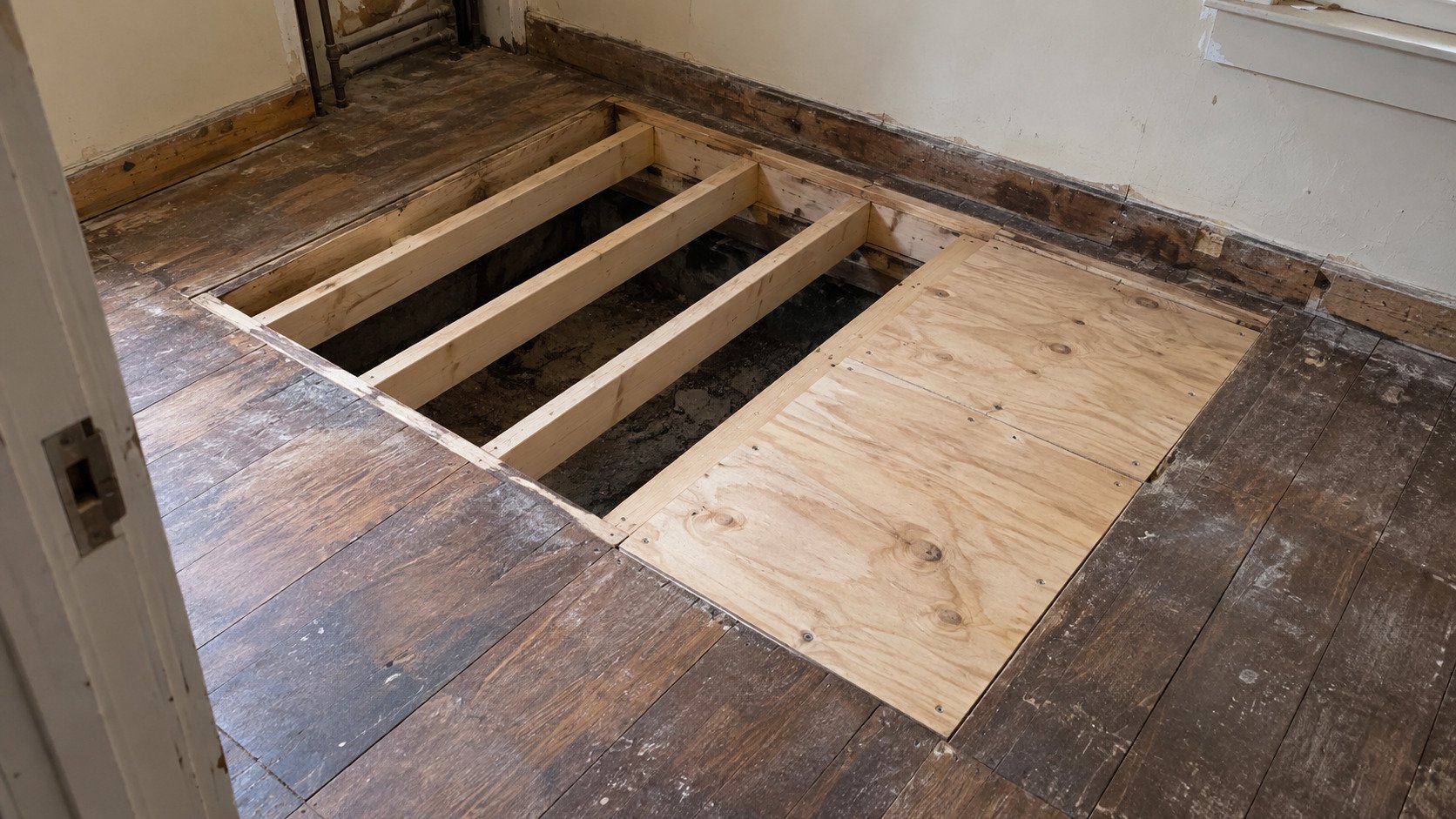
Sometimes the joists are fine and it's the subfloor that has gone: a soft spot in front of an outside door, around a toilet, or under an old leak. The flooring on top hides it until it starts to give.
Subfloor repair means cutting the damaged section back to sound material, adding support at the edges where the new piece needs it, and putting down new sheathing. If the joist under the soft spot has rotted too, it gets dealt with while the floor is open, which is the cheapest time to do it.
How we approach a floor job
This is the hardest carpentry to quote from the outside, because the extent only becomes clear once it's opened up. What we can do is be straight about that.
Look first
Crawl space, basement, and the room above. Most floor problems can be diagnosed from underneath before anything is opened up.
Quote with a range where it's needed
A firm number for what's visible, and a clear range for what isn't, with the trigger for each explained rather than buried.
Shore before cutting
Anything carrying load gets temporarily supported before the damaged member comes out. This is not optional and it's part of the price.
Talk before the number moves
If we open up and find more than expected, that's a conversation and a written change, not a surprise on the final bill.
Where framing repair ends and foundation work begins
Joists, girders, sill plates, and the posts and piers under a girder are carpentry, and that's most of what these houses need. A foundation wall that's cracking, bowing, or dropping along its length is a different trade, and so is settling that's still active and getting worse.
Symptoms from the two look alike upstairs. Underneath, they don't. If we find the foundation is the real problem, we'll tell you, even though the job isn't ours. Framing around a moving foundation is money spent on a repair that won't stay put.
For a long-span beam, a load path that isn't obvious, or anything where the foundation may be involved, we'll recommend a structural engineer. That costs money and it's worth it. Sizing a beam by guess on a span that matters isn't something anyone should do.
We won't lay new flooring over a floor that's failing underneath. And not every sloping floor in a ninety-year-old house needs fixing. Sometimes the honest advice is to leave it alone.
Crawl spaces, moisture, and why the repair keeps coming back
A high share of the rotted joists we see in this valley trace back to a crawl space that stays wet. Fix the joist, leave the conditions alone, and you'll be back in a few years.
The usual causes are ground running toward the house, no vapour barrier over bare soil, blocked or missing vents, and gutters dumping next to the foundation. None of those cost much to correct compared to another round of floor work. Some of it is work we do and some, like grading and guttering, isn't, but you'll know either way.
What's involved
Ground sloping toward the house instead of away
Bare soil with no vapour barrier
Vents blocked, or none at all
Downspouts discharging at the foundation
Plumbing leaks nobody has looked for
Insulation that has fallen and is holding moisture against the joists
What drives the cost
The variables are fairly predictable even when the extent isn't.
What's involved
How many joists or beams are affected and how long they are
Access: a full-height basement is far easier than an 18-inch crawl space
Whether temporary shoring is needed and for how long
Whether flooring or finished surfaces have to come up and go back
Whether it's sistering or full replacement
Sill plate work, which means supporting the wall above
Whether an engineer needs to be involved
Where we work
We do floor joist repair across West Virginia within about an hour of our Williamson base: Mingo and Logan counties, including Matewan, Delbarton, Chattaroy, Lenore, Kermit, Logan, Holden, Chapmanville, Man, and the places between. West Virginia only.
Searching for help with a sagging floor tends to turn up companies selling a single product. We're carpenters, and we'll tell you honestly whether the problem is the floor framing or something else. The heavier structural end of this work has its own page under this one.
Get a free quote for floor joist repair
Tell us what you're building or repairing and get a clear, no-pressure quote. Free quotes, honest answers, and craftsmanship built to last.